MONKDOCS
if !docs {
    panic("u fucked now bro")
}
How To
Guides
Github Stuff
This how to contains common stuff i often find myself doing on github
Create a new SSH key
ssh-keygen -t ed25519 -C "your_email@example.com"
Setup Git Signing Key
if needed unset so that the default openpgp format will be used
git config --global --unset gpg.format
figure out the key you want to sign with
gpg -K
set the GPG signing key
git config --global user.signingkey <key-id>
configure git to sign all commits by default
git config --global commit.gpgsign true
git config --global tag.gpgSign true
How to Play Truco Effectively: A Strategic Guide
Table of Contents
- Quick Rules Overview
- Understanding Card Values
- Game Flow
- Strategic Decision Making
- Team Communication
- Psychological Tactics
- Common Mistakes to Avoid
- Advanced Strategies
- Example Hands
- Reference: Detailed Rules
Quick Rules Overview
Truco is a trick-taking card game with bluffing elements played by 2-6 players (typically in teams). The goal is to reach 15 or 30 points by winning hands through two distinct phases: Envido (card combinations) and Truco (trick-taking).
Basic Game Setup
| Element | Details |
|---|---|
| Players | 2 (individual), 4 or 6 (in teams of 2 or 3) |
| Cards | Spanish deck of 40 cards (or standard deck with 8s, 9s, and 10s removed) |
| Deal | 3 cards to each player |
| Objective | Reach target score (15 or 30 points) by winning hands |
| Team arrangement | Team members sit alternately so no teammates are adjacent |
Basic Structure
flowchart TB
    Start[Deal 3 cards to each player] --> Envido[Envido Phase\nCard combinations of same suit]
    Envido --> EnvidoBetting{Envido\nBetting}
    EnvidoBetting -->|Called| EnvidoResolution[Compare Envido Scores]
    EnvidoBetting -->|Not Called| TrucoPhase[Truco Phase\nTrick-taking begins]
    EnvidoResolution --> TrucoPhase
    TrucoPhase --> TrucoBetting{Truco\nBetting}
    TrucoBetting -->|Stakes Raised| Response{Opponent\nResponse}
    Response -->|"Accept (Quiero)"| ContinuePlay[Continue Play\nWith Higher Stakes]
    Response -->|"Decline (No Quiero)"| EndHand[End Hand\nAward Points]
    Response -->|Raise Further| TrucoBetting
    TrucoBetting -->|No Stakes Raised| PlayTricks[Play Tricks]
    ContinuePlay --> PlayTricks
    PlayTricks --> EndHand
    EndHand --> CheckScore{Score Check}
    CheckScore -->|Target Reached| EndGame[End Game]
    CheckScore -->|Continue| NewHand[New Hand]
    NewHand --> Start
Understanding Card Values
Success in Truco requires memorizing two different card value systems - one for the Envido phase and one for the Truco phase.
Truco Phase Card Rankings
| Rank | Card | Notes |
|---|---|---|
| 1 | Ace of Swords | Highest card in the game |
| 2 | Ace of Clubs | Second highest |
| 3 | Seven of Swords | Third highest |
| 4 | Seven of Coins | Fourth highest |
| 5 | All Threes | Equal value across suits |
| 6 | All Twos | Equal value across suits |
| 7 | Ace of Cups | |
| 8 | Ace of Coins | |
| 9 | All Kings | Equal value across suits |
| 10 | All Knights | Equal value across suits |
| 11 | All Jacks | Equal value across suits |
| 12 | Seven of Cups | |
| 13 | Seven of Clubs | |
| 14 | All Sixes | Equal value across suits |
| 15 | All Fives | Equal value across suits |
| 16 | All Fours | Lowest cards in the game |
Envido Phase Card Values
| Card | Point Value | Notes |
|---|---|---|
| Cards 2-7 | Face value | Used to calculate Envido combinations |
| Jacks, Knights, Kings | 0 points | No value in Envido calculations |
| Aces | 1 point | Low value in Envido |
| Cards 8-9 (if used) | 0 points | No value in Envido calculations |
Calculating Envido Score
| Combination | Calculation | Example |
|---|---|---|
| Two cards of same suit | Card values + 20 | 7 of Coins + 6 of Coins = 33 points (7+6+20) |
| Three cards of same suit | Two highest cards + 20 | 7, 6, 2 of Swords = 33 points (uses only 7+6+20) |
| No cards of same suit | Highest single card value | King, 4 of Cups, 7 of Swords = 7 points |
Game Flow
Hand Structure Diagram
sequenceDiagram
    participant P1 as Player 1
    participant P2 as Player 2
    Note over P1,P2: Hand begins
    P1->>P2: Option to call Envido
    alt Envido Called
        P2->>P1: Accept/Reject/Raise
        alt Accept
            P1->>P2: Declare Envido scores
            Note over P1,P2: Highest score wins Envido points
        else Reject
            Note over P1,P2: Caller wins 1 point
        else Raise (Envido, Real Envido, Falta Envido)
            P1->>P2: Accept/Reject/Raise further
        end
    else Envido Not Called
        Note over P1,P2: Proceed to Truco phase
    end
    Note over P1,P2: Begin Truco phase
    loop For up to 3 tricks
        P1->>P2: Play card
        P2->>P1: Play card
        Note over P1,P2: Highest card wins trick
        Note over P1,P2: Any player can call Truco any time
        alt Truco Called
            Note over P1,P2: Opponent can Accept/Reject/Raise
        end
    end
    Note over P1,P2: Team winning 2+ tricks wins hand
    Note over P1,P2: Award points based on bets
Betting Decision Points
flowchart TD
    Start[Player's Turn] --> Decision{Call Bet?}
    Decision -->|Yes| BetType{What Type?}
    Decision -->|No| PlayCard[Play Card]

    BetType -->|Envido| EnvidoCall[Call Envido\n2 points]
    BetType -->|Truco| TrucoCall[Call Truco\n2 points]

    EnvidoCall --> OpponentResponse{Opponent\nResponse}
    TrucoCall --> TrucoResponse{Opponent\nResponse}

    OpponentResponse -->|Accept| CompareScores[Compare Envido Scores]
    OpponentResponse -->|Decline| Win1Point[Win 1 Point]
    OpponentResponse -->|Raise| EnvidoRaiseType{Raise Type}

    EnvidoRaiseType -->|Envido| DoubleEnvido[Envido+Envido\n4 points]
    EnvidoRaiseType -->|Real Envido| RealEnvido[Real Envido\n3 more points]
    EnvidoRaiseType -->|Falta Envido| FaltaEnvido[Falta Envido\nGame-ending points]

    DoubleEnvido & RealEnvido & FaltaEnvido --> ReturnToResponse[Back to Response Options]
    ReturnToResponse -.-> OpponentResponse

    TrucoResponse -->|Accept| ContinueHigherStakes[Continue with\nHigher Stakes]
    TrucoResponse -->|Decline| WinStakes[Win Current Stakes]
    TrucoResponse -->|Retruco| RetrucoCall[Retruco\n3 points]

    RetrucoCall --> RetrucoResponse{Opponent\nResponse}
    RetrucoResponse -->|Accept| ContinueRetrucoStakes[Continue with\nRetruco Stakes]
    RetrucoResponse -->|Decline| WinTrucoStakes[Win Truco Stakes]
    RetrucoResponse -->|Vale Cuatro| ValeCuatroCall[Vale Cuatro\n4 points]

    ValeCuatroCall --> ValeCuatroResponse{Opponent\nResponse}
    ValeCuatroResponse -->|Accept| ContinueValeCuatro[Continue with\nVale Cuatro Stakes]
    ValeCuatroResponse -->|Decline| WinRetrucoStakes[Win Retruco Stakes]
Strategic Decision Making
Hand Evaluation
When you receive your three cards, immediately evaluate your hand for both Envido and Truco potential:
| Aspect | Strong Hand | Medium Hand | Weak Hand |
|---|---|---|---|
| Envido strength | 28+ points | 20-27 points | <20 points |
| Truco strength | 1+ cards ranked 1-4 | Multiple middle cards (ranks 5-10) | Only low cards (ranks 11-16) |
| Overall strategy | Aggressive | Balanced | Defensive or bluffing |
When to Call Envido
| Hand Strength | Action | Rationale |
|---|---|---|
| 28+ points | Call early | High probability of winning |
| 25-27 points | Call strategically | Good chance, but consider game situation |
| 20-24 points | Call selectively | Only if position is favorable or bluffing |
| <20 points | Avoid calling | Call only as bluff when desperate |
When to Raise Stakes in Truco
| Hand Quality | Action | Timing |
|---|---|---|
| 1+ high cards (ranks 1-4) | Call Truco | Early if confident, after first trick if testing waters |
| Multiple middle cards (ranks 5-8) | Call Truco conditionally | After winning first trick or reading opponent's weakness |
| Only low cards | Bluff carefully | When opponent hesitates or when necessary for points |
| Any hand at game point | Consider aggressive calling | When few points needed for victory |
Game Situation Considerations
| Game State | Strategic Focus | Reason |
|---|---|---|
| Early game (first 4-5 hands) | Balanced approach | Establish patterns, observe opponents |
| Close score (within 3 points) | Calculated risks | Every point matters |
| Far ahead (5+ points) | Conservative, focus on Truco | Protect lead, less need for Envido risks |
| Far behind (5+ points) | Aggressive Envido and bluffing | Need high-point opportunities to catch up |
| At match point (1-2 points from winning) | Prioritize any sure points | Getting over the finish line is key |
Response Strategy Table
| Opponent Action | Your Hand | Recommended Response | Reasoning |
|---|---|---|---|
| Calls Envido | 28+ points | Accept/Raise | Strong position |
| Calls Envido | <20 points | Reject | Cut losses |
| Calls Truco | 1+ high cards | Accept/Raise | Strong trick potential |
| Calls Truco | Weak hand | Reject or bluff raise | Psychological play |
| Raises to Retruco | Very strong hand | Raise to Vale Cuatro | Maximize points |
| Raises to Retruco | Average hand | Accept carefully | Measured risk |
Team Communication
Strategic team communication is critical in Truco. Effective signaling can dramatically improve your team's performance.
Signal System
| Signal | Meaning | How to Execute | Detection Risk |
|---|---|---|---|
| Eyebrow raise | Ace of Swords | Quick, natural lift | Medium |
| Wink | Ace of Clubs | Subtle eye movement | High |
| Mouth corner pull | Seven of Swords/Coins | Small mouth movement | Medium |
| Tongue in cheek | Three (any suit) | Visible bulge in cheek | Medium |
| Nose wrinkle | Poor hand, no high cards | Brief wrinkling | Low |
| Nostril flare | Good Envido (25+) | Deep breath | Low |
| Stroking chin | Request to raise stakes | Thoughtful gesture | Low |
| Card held vertically | Holding a King | Subtle card positioning | Medium |
| Card held at angle | Seven of any kind | Tilting card | Medium |
| Finger tapping | Ready to accept higher stake | Casual table tap | Medium |
| Hand close to chest | Strong hand for Truco | Natural protective posture | Low |
| Placing cards apart | Good Envido hand | Visibly separating cards | Medium |
| Slow card play | Requesting caution | Deliberate timing | Low |
When to Signal
| Timing | Best For | Notes |
|---|---|---|
| While receiving cards | Envido strength | Most natural moment for reactions |
| Before Envido phase | Card values | Helps partner decide whether to call |
| During opponents' turns | Strategic direction | When attention is elsewhere |
| Before responding to a challenge | Asking for guidance | Quick signal before responding |
| During conversation/banter | Any crucial information | Use distraction to your advantage |
Communication Decision Diagram
flowchart TD
    HandStart[Receive Hand] --> Assess[Assess Hand Value]
    Assess --> Decision{Signal Needed?}
    Decision -->|Yes| SignalType{What to Signal?}
    Decision -->|No| PlayNormally[Play Normally]

    SignalType -->|Card Value| HighCardSignal[Signal High Card]
    SignalType -->|Envido Status| EnvidoSignal[Signal Envido Strength]
    SignalType -->|Strategy Advice| StrategySignal[Signal Strategic Direction]

    HighCardSignal & EnvidoSignal & StrategySignal --> Timing{When to Signal?}

    Timing -->|Deal Phase| SignalEarly[Signal During Deal/Early]
    Timing -->|Play Phase| SignalDuring[Signal During Play]
    Timing -->|Opponent Distracted| SignalOpportunistic[Signal When Safe]

    SignalEarly & SignalDuring & SignalOpportunistic --> Watch{Watch Partner?}
    Watch -->|Yes| InterpretPartner[Interpret Partner's Signals]
    Watch -->|No| ContinuePlay[Continue Play]

    InterpretPartner --> Adjust[Adjust Strategy Based on Team Information]
    Adjust --> Play[Play Optimally]
Developing Your Signal System
| Principle | Implementation | Benefit |
|---|---|---|
| Consistency | Use the same signals every time | Builds partner understanding |
| Naturality | Incorporate signals into normal movements | Harder for opponents to detect |
| Redundancy | Have multiple signals for crucial information | Ensures message gets through |
| Progression | Start simple, add complexity over time | Builds system as partnership develops |
| Variation | Change systems occasionally | Prevents opponents from cracking your code |
Psychological Tactics
Reading Opponents
| Behavior | Potential Meaning | How to Exploit |
|---|---|---|
| Quick acceptance of Truco | Strong hand or bluff | Play cautiously, save high cards |
| Hesitation before response | Uncertain hand | Raise stakes to pressure |
| Overly casual play | Often hiding strength | Be skeptical, play conservatively |
| Nervous signals | Likely weak hand | Consider raising stakes |
| Consistent timing shifts | Signaling to partner | Watch pattern to decode |
| Looking at partner before decision | Seeking guidance | Make decisions faster to pressure |
| Playing with cards constantly | Usually nervous or new player | Watch for tells, exploit inexperience |
| Exaggerated confidence | Often compensating for weak hand | Call their bluff with raises |
| Distracting conversation | Attempting to mask signals | Stay focused, ignore distractions |
Bluffing Techniques
| Technique | Execution | Best Situation |
|---|---|---|
| False confidence | Play quickly with weak hand | When needing 1-2 points to win |
| Hesitation bluff | Pretend uncertainty with strong hand | Against aggressive opponents |
| Pattern breaking | Establish then violate consistent timing | Mid-game when patterns established |
| Counter-signaling | Give false signals opponents can notice | When opponents are watching closely |
| Strategic folding | Surrender unimportant hands to build credibility | Early game to establish pattern |
| Table talk | Use conversation to suggest different cards | Against less experienced players |
| Double bluff | Show nervousness with strong hand | Against experienced players who read tells |
| Rush play | Play quickly to pressure decisions | When opponents tend to overthink |
Creating Psychological Pressure
| Technique | Method | Effect |
|---|---|---|
| Silence | Remain quiet during crucial moments | Creates uncomfortable tension |
| Time manipulation | Play fast/slow inconsistently | Disrupts opponent's rhythm |
| Confidence display | Maintain relaxed posture regardless of hand | Projects strength |
| Eye contact | Strategic use during key moments | Creates intimidation |
| Controlled reaction | No reaction to good/bad developments | Prevents information leakage |
| Strategic comments | Subtle remarks about game state | Plants doubts in opponents |
| Pattern establishment | Create expectations, then break them | Conditions opponents for manipulation |
Common Mistakes to Avoid
| Mistake | Consequence | Better Approach |
|---|---|---|
| Leading with highest cards | Wasting power cards | Save strongest cards for later tricks |
| Calling Envido with weak hands | Losing points unnecessarily | Pass or use as strategic bluff |
| Obvious signaling | Opponents counter your strategy | Practice subtlety, mix signals |
| Consistent play timing | Reveals hand strength | Vary your timing regardless of hand |
| Forgetting played cards | Miscalculating odds | Track cards mentally or discreetly |
| Emotional reactions | Gives away information | Maintain poker face consistently |
| Raising without team consensus | Undermining partner's strategy | Establish signals for raising approval |
| Playing too conservatively | Missing opportunities | Balance caution with calculated risks |
| Ignoring game score | Inappropriate risk-taking | Adapt strategy to current score |
| Predictable patterns | Opponents can anticipate moves | Vary your play style strategically |
| Over-bluffing | Credibility loss | Bluff selectively, backed by occasional strength |
| Neglecting to watch for signals | Missing crucial information | Divide attention between cards and players |
Advanced Strategies
The Pardas (Tie) Strategy
sequenceDiagram
    participant You
    participant Opponent
    Note over You,Opponent: You hold: Ace of Swords (highest) and Two low cards
    Note over You,Opponent: First Trick
    You->>Opponent: Play medium card (e.g., a Two)
    Opponent->>You: Play matching value card
    Note over You,Opponent: Trick ends in tie (parda)
    Note over You,Opponent: Second Trick
    You->>Opponent: Play Ace of Swords (highest card)
    Opponent->>You: Play any card (will lose)
    Note over You,Opponent: You win second trick
    Note over You,Opponent: Third Trick
    Note over You,Opponent: Opponent must lead, disadvantage
    Opponent->>You: Play their highest card
    You->>Opponent: Play low card (may lose trick)
    Note over You,Opponent: Even if you lose third trick, you win hand by having won second trick after tie
Card Distribution Awareness
| Card Type | Quantity in Deck | Strategic Implication |
|---|---|---|
| Highest cards (ranks 1-4) | 4 cards | ~10% chance per player of holding one |
| Middle-high cards (ranks 5-8) | 12 cards | ~30% of all cards, common in hands |
| Middle-low cards (ranks 9-12) | 12 cards | ~30% of all cards, common in hands |
| Lowest cards (ranks 13-16) | 12 cards | ~30% of all cards, common in hands |
Advanced Betting Strategies
| Game Situation | Strategy | Rationale |
|---|---|---|
| Leading by 5+ points | Conservative betting | Protect lead, force opponents to take risks |
| Trailing by 5+ points | Aggressive Falta Envido calls | High-risk, high-reward catchup strategy |
| Partner signals strong hand | Raise stakes early | Capitalize on combined team strength |
| Late game (approaching score limit) | Call Truco with marginal hands | Psychological pressure when stakes are highest |
| After winning Envido | More aggressive in Truco phase | Opponents often demoralized after Envido loss |
| Opponent showed hesitation | Immediate raising | Exploit psychological weakness |
| Both teams near winning score | Focus on Truco over Envido | Direct route to necessary points |
| Strong Envido but weak Truco | Call Envido, avoid Truco | Compartmentalize your strategy |
| First hand of game | Conservative play | Observe opponents before taking risks |
| After a loss | Change your pattern | Prevent opponents from reading your style |
Strategic Card Leading
| Card Type | When to Lead | Strategic Purpose |
|---|---|---|
| Middle cards (ranks 7-12) | First trick | Probe opponent's hand without revealing strength |
| Lowest cards (ranks 13-16) | When ahead in tricks | Preserve stronger cards for crucial moments |
| Highest cards (ranks 1-4) | Second trick after tie | Maximum impact, often wins hand |
| Cards of same rank as partner's signal | After partner signals | Create coordinated strategy |
| Middle-high card (ranks 5-8) | When trying to win first trick | Reasonable chance without showing top cards |
| Unexpected card | After establishing patterns | Break your own pattern to confuse opponents |
Example Hands
Example 1: Strategic Envido Play
sequenceDiagram
    participant You as You (Team A)
    participant P2 as Partner (Team A)
    participant O1 as Opponent 1 (Team B)
    participant O2 as Opponent 2 (Team B)
    Note over You,O2: You receive: 6 of Coins, 5 of Coins, 3 of Cups
    Note over You,O2: Your Envido: 31 points (6+5+20)
    Note over You,O2: Truco Hand: One medium card (3)
    You->>O1: Call "Envido" (stake: 2 points)
    O1->>You: Raises "Envido" (stake: 4 points)
    Note over You,O2: Partner signals weak Envido
    You->>O1: Accept "Quiero" (not raising further)
    Note over You,O2: Players declare Envido values
    You->>All: "31 points"
    O1->>All: "27 points"
    Note over You,O2: You win Envido (4 points)
    Note over You,O2: Truco phase begins
    Note over You,O2: With weak Truco hand, play conservatively
    Note over You,O2: If opponents call Truco, reject unless partner signals
Analysis:
- With a strong Envido hand (31 points) but a weak Truco hand, you prioritize winning the Envido phase
- When opponent raises, you don't get greedy with Real Envido since your partner signaled weakness
- After winning Envido, you shift to defensive play for Truco phase
- This balanced approach secures 4 points even with a mediocre overall hand
Example 2: Bluffing in Truco Phase
sequenceDiagram
    participant You as You
    participant Opp as Opponent
    Note over You,Opp: You have: 4 of Swords, 5 of Clubs, 7 of Cups
    Note over You,Opp: (Relatively weak hand)
    Note over You,Opp: First Trick
    You->>Opp: Play 5 of Clubs (middle value)
    Opp->>You: Play King (higher than your 5)
    Note over You,Opp: Opponent wins first trick
    Note over You,Opp: Before second trick
    You->>Opp: Call "Truco" confidently
    Opp->>You: Hesitates, then "Quiero" (accepts)
    Note over You,Opp: Second Trick
    Opp->>You: Plays cautiously (Jack)
    You->>Opp: Play 7 of Cups (beats Jack)
    Note over You,Opp: You win second trick
    Note over You,Opp: Third Trick
    You->>Opp: Play 4 of Swords quickly
    Opp->>You: Concerned about your confidence, plays conservatively
    Note over You,Opp: You might win third trick through psychological play
Analysis:
- After losing the first trick, you create psychological pressure with a confident Truco call
- Your timing and confidence make the opponent question their hand strength
- In the second trick, opponent plays cautiously due to your perceived confidence
- By maintaining consistent confidence, you maximize chances of winning with weak cards
- The bluff works because it's timely (after losing a trick) and convincingly executed
Example 3: Team Play Coordination
| Phase | Your Hand | Partner's Signals | Your Action | Outcome |
|---|---|---|---|---|
| Deal | 3 of Clubs, 7 of Swords, 2 of Cups | Partner signals holding Ace of Swords | Plan to support partner's strong card | Team coordination |
| Envido | Weak Envido (3 points) | Partner signals moderate Envido | Skip Envido call | Avoid weak position |
| First Trick | Play 2 of Cups (low card) | Save stronger cards | ||
| Opponent plays King, Partner plays 5 | Opponent wins first trick | |||
| Second Trick | Opponent leads with Jack | |||
| Partner signals to raise stakes | Call "Truco" | Support partner's strong hand | ||
| Opponents accept | Raise stakes to 2 points | |||
| Partner plays Ace of Swords (wins trick) | Team wins second trick | |||
| Third Trick | Partner leads with 2 of Swords | Play 7 of Swords (medium-high) | Support with stronger card | |
| Opponent plays 6 of Clubs | Team wins hand | |||
| Result | Team wins 2 points through coordination |
Reference: Detailed Rules
Envido Betting Points Table
| Scenario | Points Awarded |
|---|---|
| Envido → Quiero | Winner gets 2 points |
| Envido → No quiero | Challenger gets 1 point |
| Envido → Envido → Quiero | Winner gets 4 points |
| Envido → Envido → No quiero | Initial challenger gets 2 points |
| Envido → Real Envido → Quiero | Winner gets 5 points |
| Envido → Real Envido → No quiero | Initial challenger gets 2 points |
| Envido → Falta Envido → Quiero | Winner gets enough points to win or predetermined amount |
| Envido → Falta Envido → No quiero | Initial challenger gets 2 points |
Truco Betting Points Table
| Scenario | Points Awarded |
|---|---|
| Truco → Quiero | Winner gets 2 points |
| Truco → No quiero | Challenger gets 1 point |
| Truco → Retruco → Quiero | Winner gets 3 points |
| Truco → Retruco → No quiero | Initial challenger gets 2 points |
| Retruco → Vale cuatro → Quiero | Winner gets 4 points |
| Retruco → Vale cuatro → No quiero | Retruco caller gets 3 points |
Glossary of Key Terms
| Term | Definition | Strategic Importance |
|---|---|---|
| Envido | Betting phase based on card combinations of same suit | Primary source of multiple points |
| Truco | Main trick-taking phase and first level of raising stakes | Core gameplay mechanism |
| Quiero | "I accept" - accepting a challenge | Continues play with higher stakes |
| No quiero | "I don't accept" - declining a challenge | Cuts losses when disadvantaged |
| Retruco | Second level of raising stakes (to 3 points) | Intermediate escalation |
| Vale cuatro | Third level of raising stakes (to 4 points) | Maximum standard escalation |
| Flor | Three cards of same suit (in variants that use it) | Automatic win for Envido |
| Mano | The player to the dealer's right who plays first | Advantage in Envido ties |
| Parda | A tie in a trick when cards of equal rank are played | Creates strategic lead dynamics |
| Falta Envido | A bet that puts enough points at stake to end the game | Highest risk/reward play |
| Real Envido | A 3-point raise in the Envido phase | Significant point escalation |
| Mazo | To fold or surrender a hand | Strategic withdrawal to minimize losses |
Slackline Setup Guide
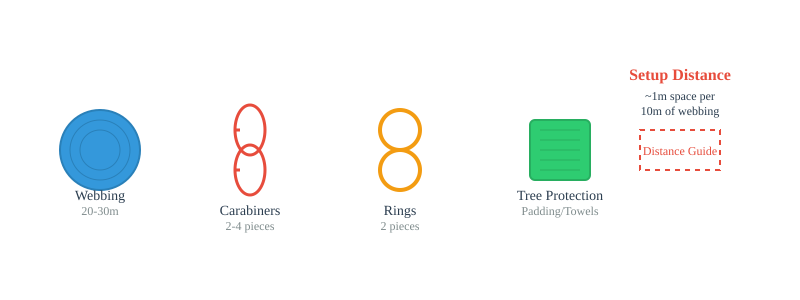
This comprehensive guide will walk you through setting up a primitive slackline using basic equipment. Follow the step-by-step instructions below to learn the proper technique for creating a safe and functional slackline.
Quick Overview
Setting up a slackline requires:
- 20-30 meters of slackline webbing
- 2-4 carabiners
- 2 rings for tensioning
- Tree protection (padding or towels)
- Two suitable trees spaced appropriately
Equipment Needed 📋
Essential Equipment:
- Webbing: 20-30 meters of slackline webbing
- Carabiners: 2-4 carabiners (minimum 2, extras for easier tensioning)
- Rings: 2 rings for the tensioning system
- Tree Protection: Padding or towels to protect bark
Color Legend
The diagrams use the following color coding:
- Brown: Tree Trunk
- Green: Tree Protection
- Blue: Slackline Webbing
- Red: Carabiners
- Orange: Rings
Step-by-Step Setup Guide
Step 1: Equipment Overview
What you'll need for a primitive slackline setup:
Here's what you'll need for a primitive slackline setup. The key components are the webbing, carabiners, rings, and tree protection.
Step 2: Creating the Anchor Knot
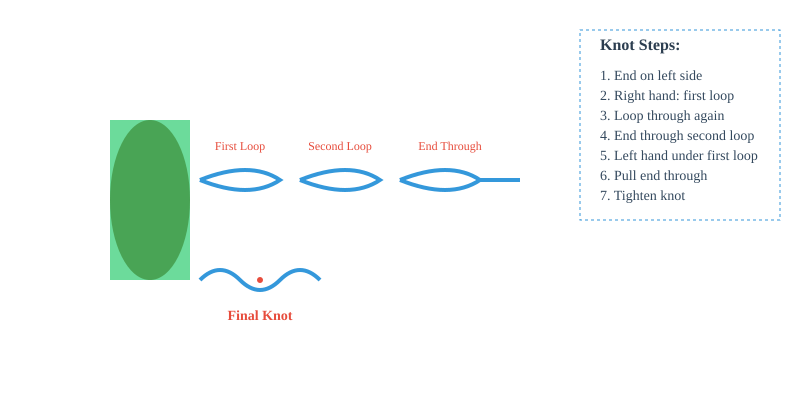
Instructions:
- Place webbing end on left side
- Right hand creates first loop with twist
- Loop through second time
- End goes through second loop
- Left hand goes under first loop
- Pull end through first loop
- Tighten
Step 3: Both Anchor Points Complete
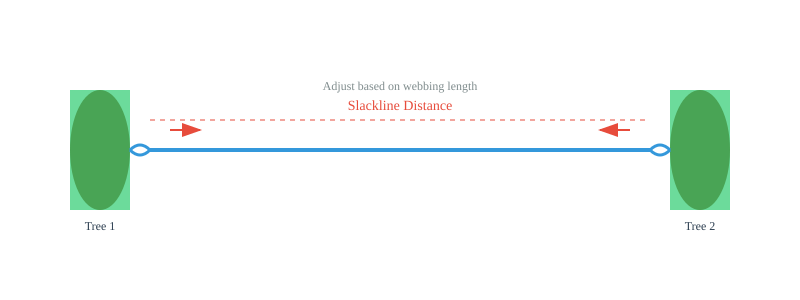
Setting up the second anchor:
Repeat the same knot process on the second tree. Both trees should have protection padding and the same anchor knot. The webbing now spans between both trees.
Step 4: Setting Up the Tensioning Rings
Preparing the tensioning system:
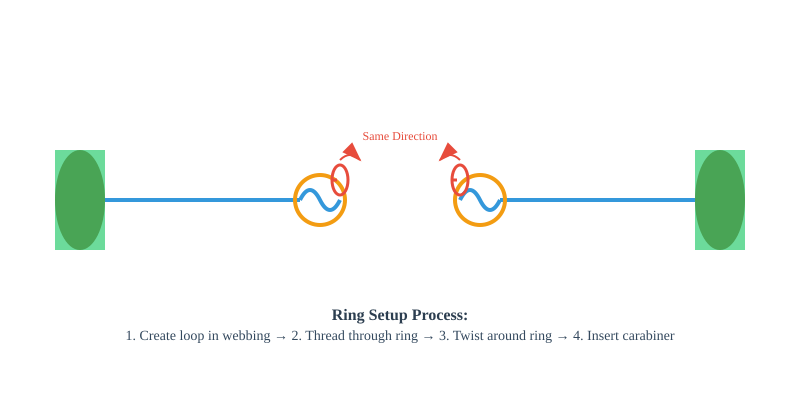
Create small loops in the webbing and thread them through the rings. Twist the loops around the rings to create space for carabiners. Ensure both carabiner openings face the same direction.
Step 5: Threading the Tensioning System
Threading pattern:
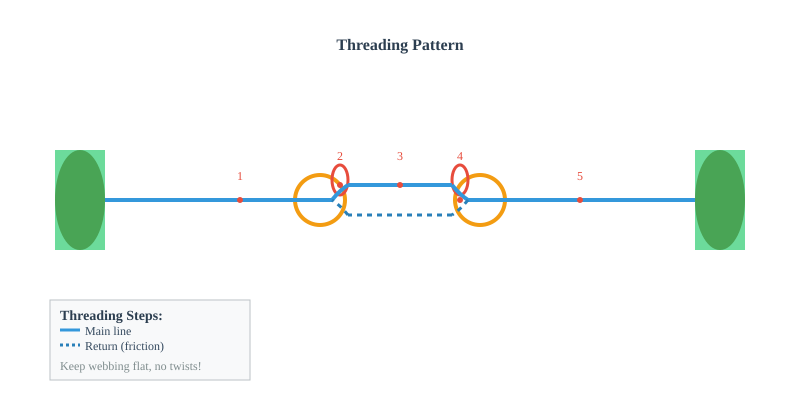
Thread the webbing through the carabiners following the specific pattern: bottom-to-top through first carabiner, top-to-bottom through second carabiner, then bottom-to-top again but underneath the first section for friction.
Step 6: Tensioning the Slackline
Building tension:
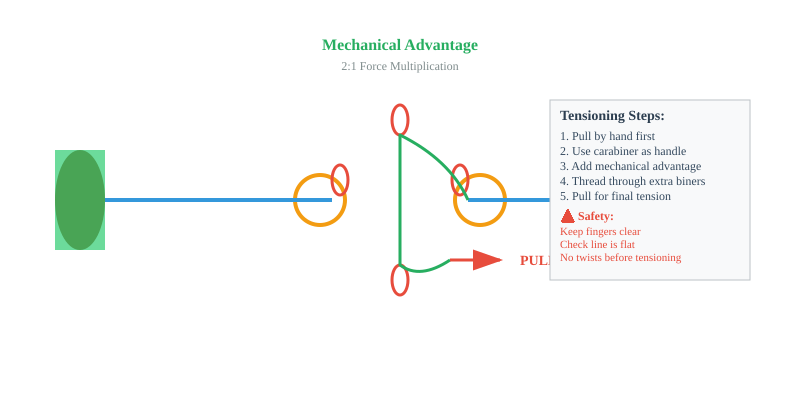
Start with hand tensioning, then use additional carabiners as handles for more leverage. For maximum tension, create a mechanical advantage system by threading the webbing through extra carabiners to multiply your pulling force.
Step 7: Complete Slackline Setup
Final result:
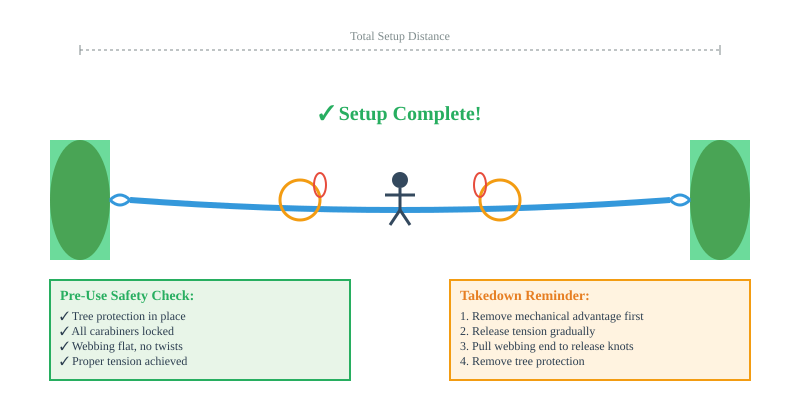
Your primitive slackline is now complete and ready for use! The setup shows both anchor points, tensioning system, and proper webbing path. Remember to check all connections before use and always prioritize safety.
Key Success Tips 🎯
Tree Protection: Always use padding to prevent bark damage
Flat Webbing: Keep webbing flat throughout - no twists
Gradual Tension: Build tension slowly and check connections
Safety First: Test setup before full use
Safety Considerations
Before Setup
- Tree Selection: Choose healthy, mature trees with trunks at least 6 inches in diameter
- Tree Protection: Always use padding to prevent damage to tree bark
- Distance: Allow approximately 1 meter of space for every 10 meters of webbing
During Use
- Inspection: Check all connections and equipment before each session
- Progression: Start with low, loose lines before advancing to higher tensions
- Supervision: Beginners should practice with experienced slackliners
Environmental Responsibility
- Leave No Trace: Remove all equipment and padding after use
- Bark Protection: Never set up without proper tree protection
- Respect Areas: Follow local regulations and land use policies
Troubleshooting Common Issues
Line Won't Hold Tension
- Check that all carabiners are properly locked
- Ensure webbing is threaded correctly through the tensioning system
- Verify anchor knots are tight and properly formed
Excessive Bounce or Instability
- Reduce initial tension - primitive lines should have some give
- Check that the line is completely flat with no twists
- Ensure proper anchor height (usually chest level)
Equipment Slipping
- Re-tighten all knots and connections
- Check that rings are properly positioned
- Verify carabiner gates are facing the correct direction
Remember: Slacklining takes practice and patience. Start with shorter, lower lines and gradually progress as your balance and confidence improve.
HEllo
Photo